
Conveyor
Customized Conveyor Solution Using Our New Belt Conveyors
Elcom designed and implemented a customized conveyor solution based on its new range of belt conveyors, aimed at optimizing an industrial production line. This project also provided an opportunity to demonstrate the flexibility and compatibility of our new conveyor range.
Context and Challenges of an Industrial Conveyor System
As part of the modernization of an industrial production line, a company in the electrical equipment sector was looking for a reliable alternative to an existing conveyor system that had become a source of recurring operational issues.
The existing installation, designed by another supplier, experienced repeated malfunctions that were incompatible with production requirements. Faced with these technical limitations, the objective was twofold: first, to restore reliable operation, and second, to integrate a solution capable of adapting to the site’s specific constraints.
Beyond simply replacing faulty equipment, the project also aimed to redesign the product transfer architecture in order to sustainably improve the performance of the installation.
Objectives of a High-Performance Conveyor Line
Elcom’s teams needed to design a system capable of:
- Transporting plastic parts produced by an injection molding process
- Withstanding temperatures of up to 140°C
- Ensuring a continuous flow between multiple production stations
- Simplifying maintenance operations
- Integrating into an existing environment using H'10 45 aluminum profile structures
- Reducing constraints related to product transfers between conveyors

Production Constraints and Industrial Material Flow
The project involved several technical challenges:
The first challenge concerned the high temperature of the transported parts. Products leaving the injection molding process had to be conveyed immediately after production, requiring a design suitable for demanding thermal conditions.
The second challenge resulted from the building configuration and the positioning of existing equipment. The new installation needed to integrate into the production line without major modifications while ensuring smooth product transfer.
Finally, the solution had to offer a high level of reliability to prevent the recurrence of issues experienced with the previous system.

What Is a Custom Belt Conveyor Solution?
A custom belt conveyor solution allows products or components to be automatically transported throughout an industrial process while being precisely adapted to the constraints of the production environment.
- The nature of the products being transported
- Operating temperatures
- Space constraints
- Production rates
- Maintenance requirements
- Interfaces with other equipment on the production line
This approach makes it possible to achieve a perfectly integrated installation while optimizing industrial performance and overall process reliability.
The Customized Industrial Conveyor Solution Implemented
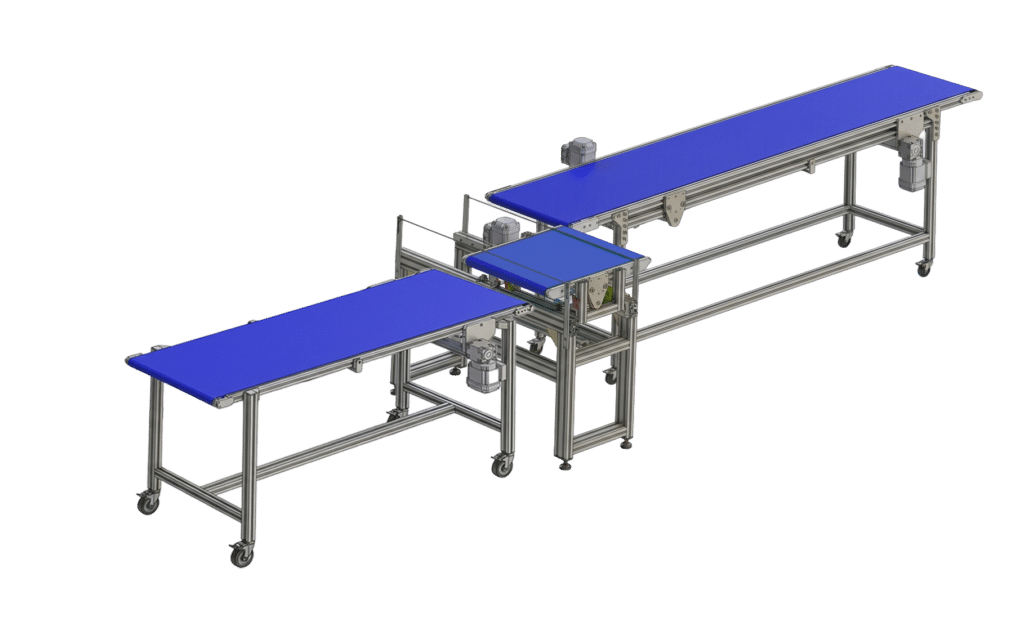
To meet the project’s requirements, Elcom developed a belt conveyor solution consisting of three complementary conveyors.
The installation is based on two offset straight conveyors connected by a third intermediate conveyor. This intermediate conveyor transfers products between the two main units and ensures production flow continuity.
This architecture also compensates for building layout constraints while maintaining smooth product transportation.
The conveyors were designed using the new Elcom conveyor range, whose modular design enabled direct integration onto H’10 45 structures, something that was not possible with the previous conveyor generation.
To improve transfer quality, the solution incorporates a compact 16 mm knife-edge conveyor end. This design minimizes the gap between conveyors and reduces the risk of product instability during transfers.
Finally, this project represents one of the first real-world applications validating the performance of the new conveyor range in a demanding industrial environment.
Technology and Expertise Behind Elcom Industrial Conveyors
Significantly Simplified Maintenance
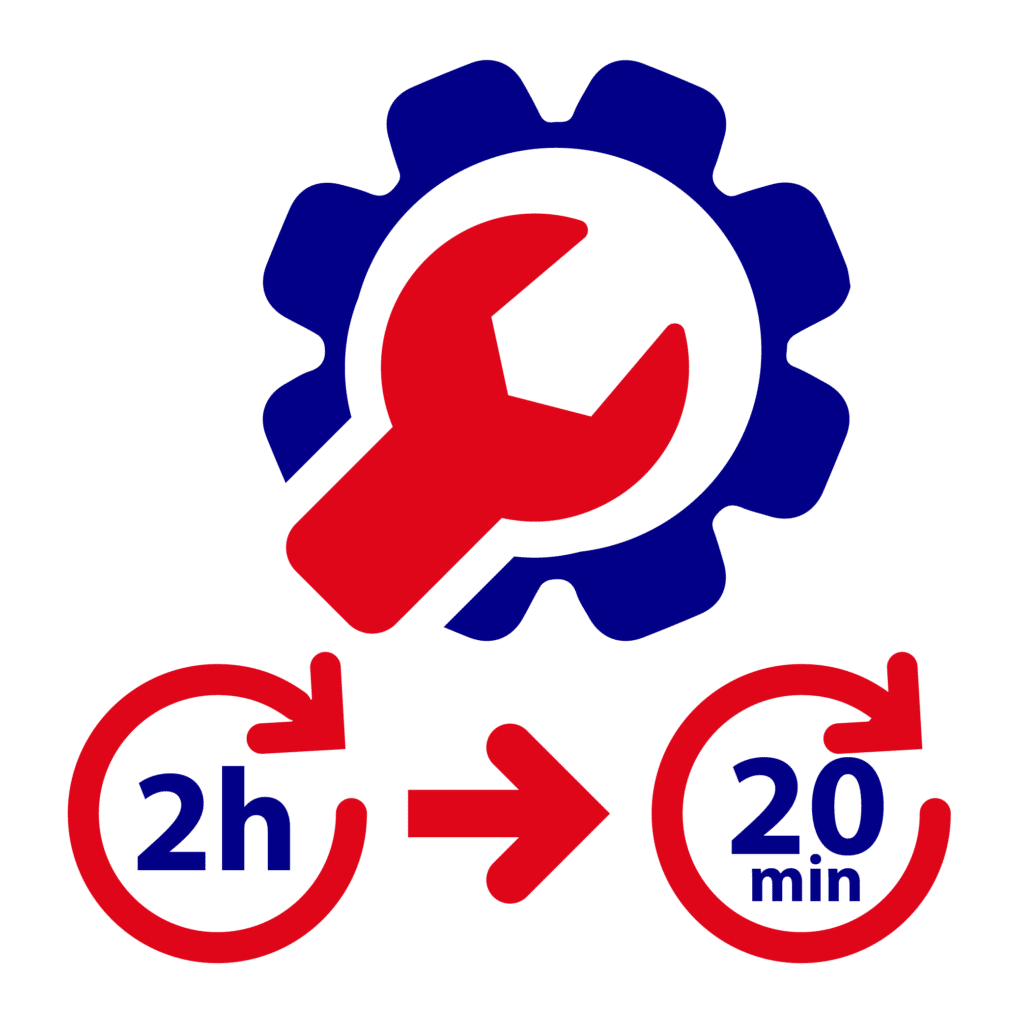
One of the major improvements brought by the new conveyor generation concerns pulley alignment operations.
The time required for this intervention has been reduced from two hours to only twenty minutes, representing approximately an 83% reduction in maintenance time.

Optimized Technical Performance
The project enabled the integration of a 600 mm wide conveyor while maintaining excellent transfer quality through the use of highly compact knife-edge conveyor ends.
At just 16 mm, these conveyor ends provide greater compactness than competing solutions, which are typically limited to 20 mm.
Enhanced Modularity
The new Elcom conveyor range demonstrated its full flexibility throughout this project.
Compatibility with H’10 45 structures enabled rapid adaptation to site constraints and validates the ability of the range to meet a wide variety of industrial configurations.


Simplified maintenance

Optimized technical performance
Enhanced modularity
Results and Benefits of a Modular Industrial Conveyor
- Reliable transportation of high-temperature plastic parts
- Improved production flow continuity through the three-conveyor architecture
- Significant reduction in maintenance downtime
- Easy integration into an existing industrial environment
- Optimized product transfers thanks to the compact 16 mm knife-edge conveyor end
- Industrial validation of Elcom's new conveyor range
Beyond the immediate technical benefits, this project also represents a strategic success. It enabled Elcom to position itself as a credible and high-performance alternative.
Focus: What Is the Purpose of a Knife-Edge Conveyor End on a Flat Belt Conveyor?
On a belt conveyor, a knife-edge conveyor end is a specially designed end section featuring an extremely narrow nose with a small-diameter roller or transfer blade. Its purpose is to minimize the transfer gap between two belt conveyors or between a conveyor and a machine.
Its main benefits include:
- Ensuring the safe transfer of small parts without risk of falling
- Preventing jams during conveyor-to-conveyor transfers
- Reducing the unsupported zone at the conveyor end
- Improving the smoothness and reliability of conveying operations
In industrial applications involving injection-molded plastic parts, a knife-edge conveyor end is particularly useful when products are small, lightweight, or susceptible to tipping during transfers.

knife-edge for conveyor belt: How does it differ from a Standard Conveyor End?


A knife-edge conveyor end reduces the gap between two belt conveyors, enabling smoother and more continuous product transfers.
This solution minimizes the risk of products tipping or becoming unstable when moving from one conveyor to another.
FAQ – Custom Flat Belt Conveyors
In which industries are flat belt conveyors used?
The flat belt conveyor is used in many industrial sectors, such as the automotive, plastics, logistics, packaging, and assembly industries. Its versatility makes it an ideal solution for automating production flows and transporting products of various sizes.
What types of products can be transported by a flat belt conveyor?
A flat belt conveyor is designed to transport a wide variety of products when a flat and continuous conveying surface is required. Typical applications include:
- Cartons and parcels
- Plastic bins and containers
- Mechanical parts and industrial components
- Injection-molded plastic parts
- Packaged products (bags, boxes, bottles, trays)
- Packaged food products
- Light to medium loads requiring stable and consistent transportation
What is a dual-belt conveyor used for?
A dual-belt conveyor is used to transport products while leaving a free space between the two belts.
This configuration keeps products stable while facilitating access to their underside for assembly, inspection, marking, or automated handling operations.
It is particularly suitable for flat products and components requiring intervention during the conveying process.